
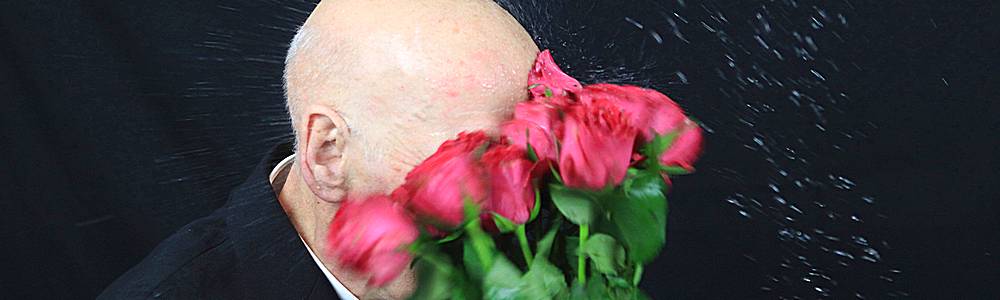
Nigel Rolfe, United Kingdom/Ireland
Born in 1950, Isle of Wight, United Kingdom. Lives and works in Dublin
Nigel Rolfe is widely recognised as one of the seminal figures in the history of performance art and among its leading contemporary practitioners. Since relocating to Ireland in 1975, he has developed an internationally acclaimed practice that spans more than five decades and has profoundly influenced several generations of artists. Working nomadically across the world, Rolfe continues to create performances internationally while maintaining an interdisciplinary practice encompassing performance, photography, video, sound and music.
Originally trained as a sculptor, Rolfe began making performances in 1969, describing his early works as “Sculptures in Motion”—actions in which materials were transformed through time, movement and physical engagement. Although his work has gradually incorporated photography, film, sound and installation, it has remained rooted in a sculptural understanding of process, material and the body’s direct encounter with the world. For Rolfe, performance is not simply a medium but a way of thinking: an immediate, live engagement through which meaning emerges in the presence of those who witness it.
As Rolfe has written, the central contention of his practice has remained constant for more than half a century:
“Art making is a live and direct way forward. Not valuable for what’s left behind but what may be discovered in the maybe of the here and now. Directly before the eyes of the beholder. Being and doing before the gaze of those bearing witness.”
Throughout his career Rolfe has investigated the relationship between the human body, material forces and political reality. His performances often place the body in situations of physical and psychological intensity, testing endurance, vulnerability and resistance while confronting broader questions of power, conflict, identity and social inequality. Over time these direct material encounters evolved into increasingly sophisticated multimedia productions integrating sound, photography and broadcast-quality video. Rather than functioning as documentation, video became an active artistic medium through which he explored perception, memory and the limits of bodily experience.
Rolfe’s work has been presented extensively throughout Europe, North and South America, Asia and beyond, in more than thirty countries across five continents. His performances and installations have been shown at institutions including De Appel (Amsterdam), Franklin Furnace (New York) and the Institute of Contemporary Arts (London). Major retrospectives have been organised by the Irish Museum of Modern Art, Dublin (1994), and the Musée d’Art Moderne de la Ville de Paris (1996) and at the Red Brick Art Museum in Beijing (2018). He has participated in numerous international biennials, including those of Venice, São Paulo, Busan, Gwangju, Dublin and Paris.
His work has also reached audiences far beyond the contemporary art world. The performance Hand On Face was broadcast worldwide during the Nelson Mandela 70th Birthday Tribute Concert at Wembley Stadium in 1988, reaching an estimated audience of more than 600 million viewers in 67 countries. Alongside his visual art practice, Rolfe has maintained a significant engagement with music and sound production. His song Middle of the Island, recorded by Christy Moore and Sinéad O’Connor (1984), has become a recognised classic of Irish contemporary music, while Lament (Real World Records, 1992) was praised by Rolling Stone as “a stunning piece of work… each track is a call to the spirits of life in the face of devastation.”
Alongside his artistic practice, Rolfe has been an influential educator and mentor. Between 1982 and 2019 he taught in the School of Fine Art at the Royal College of Art in London, where he was appointed Professor of Fine Art (Performance) in 2014. Throughout his academic career he played a central role in graduate education, artistic research and critical discourse, shaping the development of performance art within one of Europe’s leading art institutions.
Working across live performance, photography, video, sound and installation, Rolfe continues to develop a practice that combines sculptural thinking with political engagement, poetic intensity and material experimentation. His work insists upon the transformative potential of live artistic action, where meaning is not predetermined but emerges through the encounter between body, material, place and witness.
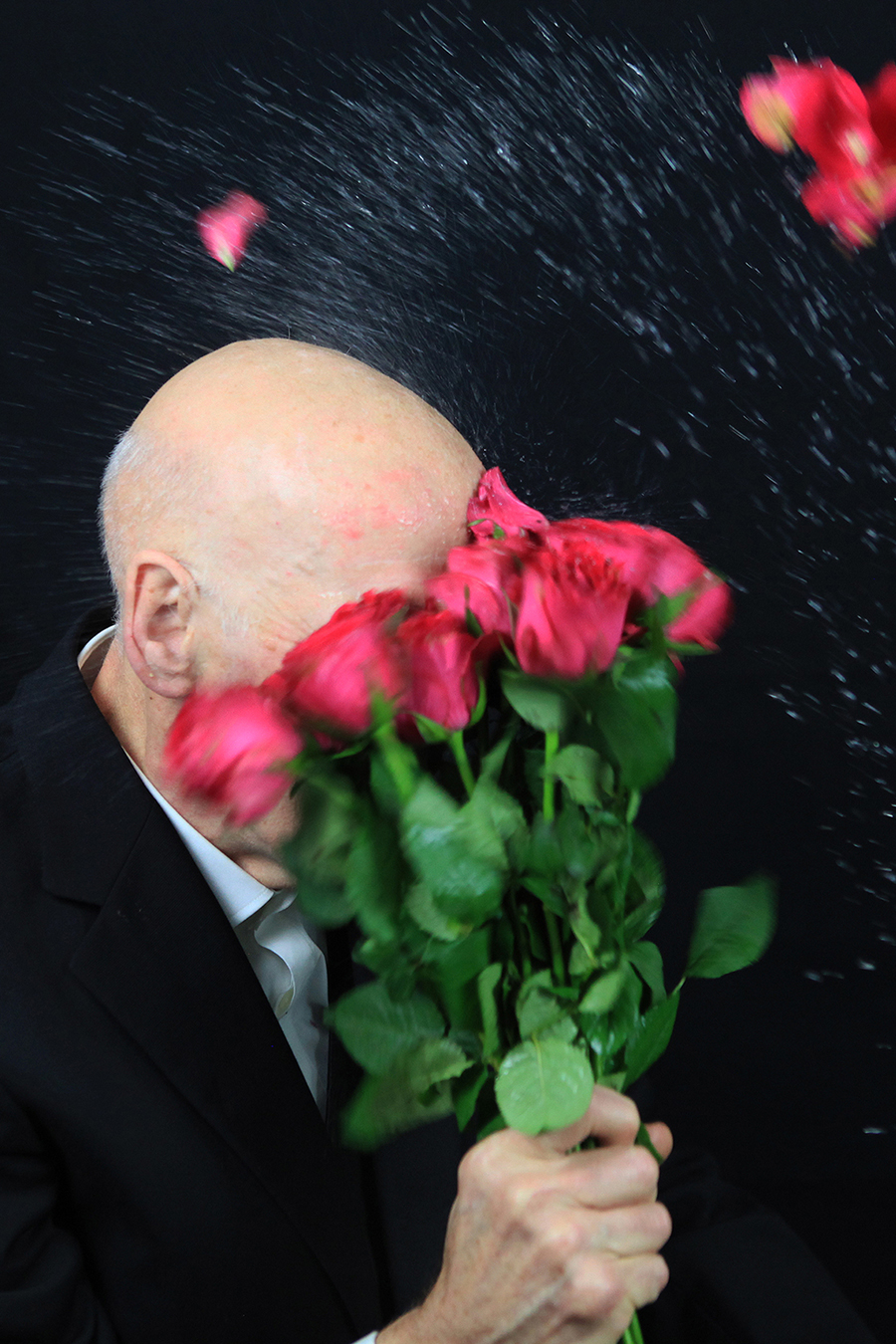
Nigel Rolfe. Courtesy the artist.
2026© Live Action. ALL Rights Reserved.
