
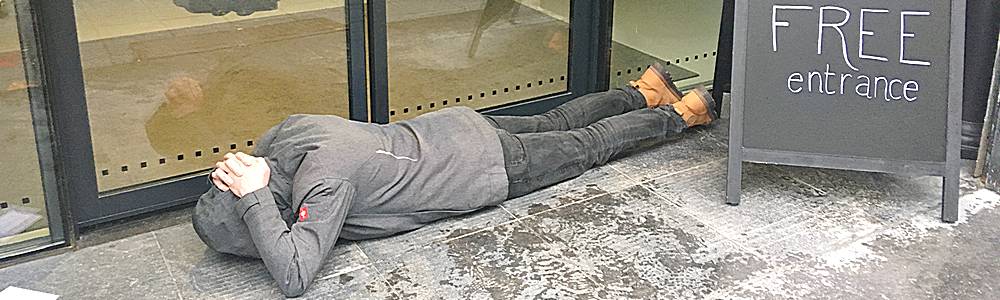
Danny Devos, Belgium
Born 1959 in Vilvoorde, Belgium. Lives and works in Antwerp
Danny Devos, also known as DDV, is a Belgian performance, sound, and visual artist whose uncompromising practice has explored the body, violence, crime, power, and the limits of human behaviour since 1979. Over the past 47 years, he has carried out more than 170 performances internationally, developing a singular position as a performance artist while maintaining a deliberately critical voice both within and against the established art world.
In the early 1980s, Devos began combining confrontational bodily performance with industrial noise while undertaking an extensive psychological and artistic investigation into murder and criminal behaviour. From 1987 onward, he corresponded with convicted murderers and serial killers, including Freddy Horion, Michel Bellen, and John Wayne Gacy. These exchanges became part of a long-term body of work encompassing performances, objects, installations, photographs, archival material, and correspondence. Rather than approaching crime as spectacle, Devos investigates the unstable boundaries between violence, representation, identity, and the cultural construction of the criminal figure.
In 1981, he co-founded Club Moral with artist Anne-Mie Van Kerckhoven, an influential artist initiative and pioneering noise music project. His practice has also extended into long-term engagements with the artistic legacies of Gordon Matta-Clark and James Lee Byars. From 1998 to 2004, Devos served as Social Commissioner and chairman of NICC, contributing to the process that led to the official recognition of the legal and social status of artists in Belgium in 2003. In 2005, he moved to Beijing to develop and manage Art Farm for his friend and colleague Wim Delvoye.
From 2005 until recently, Devos carried out Diggin’ for Gordon, a durational work inspired by Gordon Matta-Clark. Performed at a secret location and accessible to audiences only through a webcam, the work extended his investigation of presence, absence, secrecy, duration, and the unstable status of performance documentation.
Until a serious bicycle accident in 2013, Devos frequently used his own body as the primary instrument of confrontational performances. In recent years, he has developed a distinctive approach to the reconstruction of performance art by creating three-dimensional scale models of historical performances and installations using 3D printing, laser cutting, and CNC milling.
Since 2021, Devos has also investigated artificial intelligence and text-to-image machine-learning models, translating AI-generated images into physical reliefs and sculptural objects. In 2025, he created 650 images using titles from a 1974 exhibition catalogue of works by J. M. W. Turner as prompts for a text-to-image model. In parallel, he uses AI to generate speculative images of performances for which little or no photographic documentation survives.
Across performance, sound, installation, archival research, sculpture, and artificial intelligence, Devos’s work remains a persistent investigation into the human condition and the unstable boundaries between body and image, fact and reconstruction, archive and fiction.
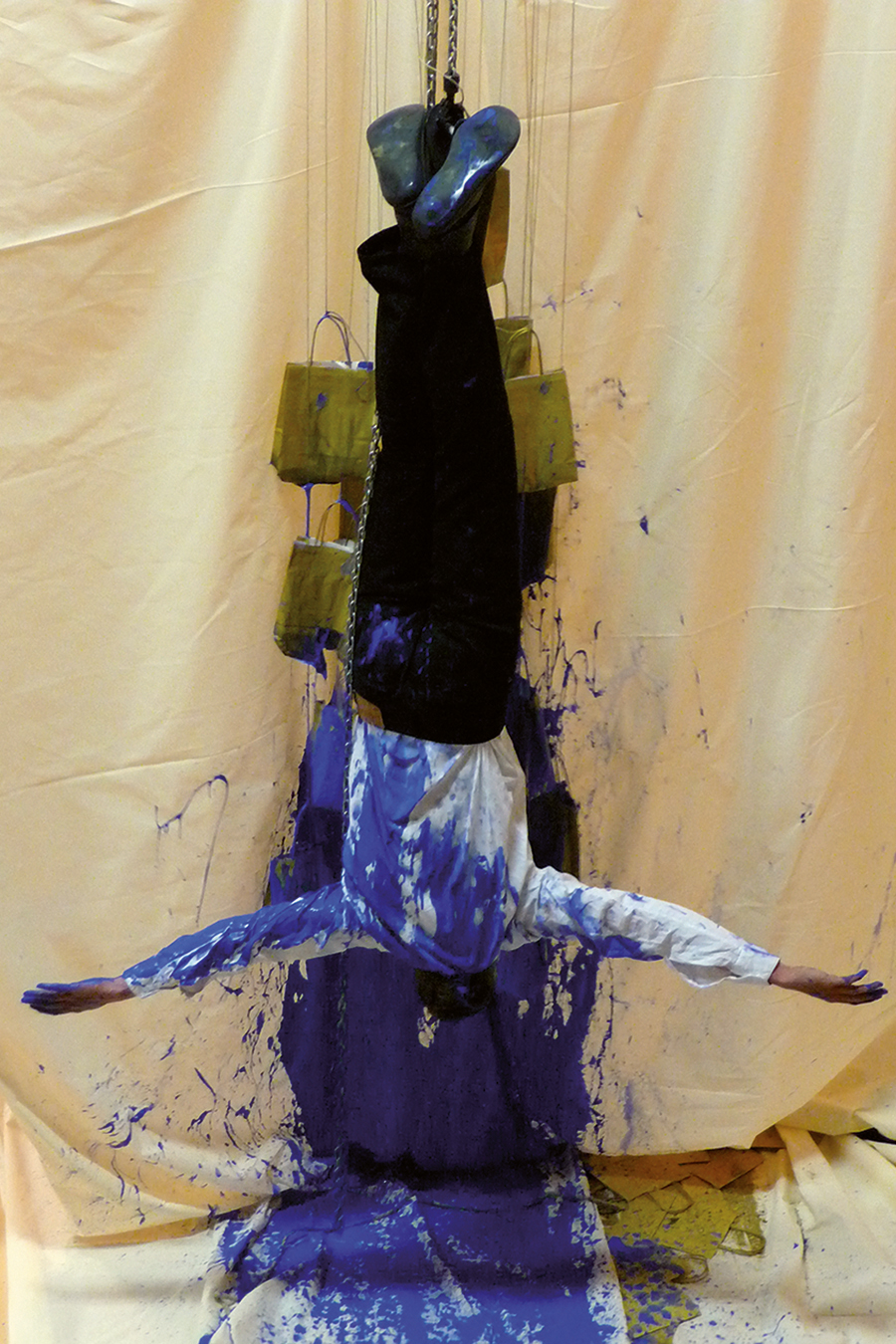
Danny Devos. Courtesy the artist.
2026© Live Action. ALL Rights Reserved.
