
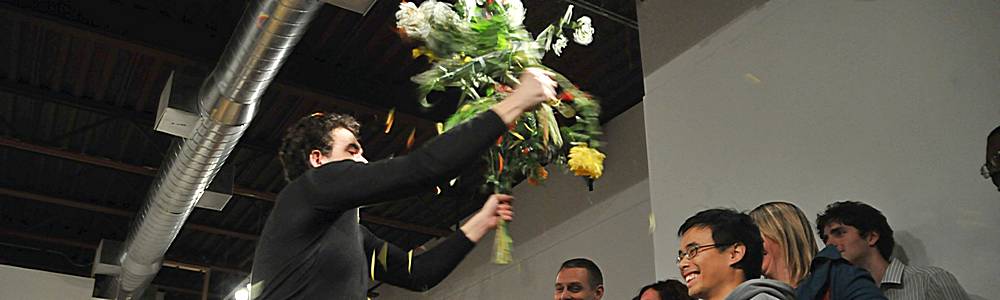
Maurice Blok, Netherlands/Finland
Born in 1979, lives and works in Lahti, Finland
Maurice Blok is a Dutch-born visual artist whose practice moves between sculpture, performance, experimentation, and the physical transformation of materials. Trained in sculpture and photography, he studied at the Faculty of Art and Design (AKI) in Enschede, the Netherlands, where he concentrated on sculpture and drawing. Although his work has increasingly developed through live action and performance, Blok continues to approach his practice from what he describes as a fundamentally sculptural attitude.
During his studies, Blok became increasingly interested in what happens before an artwork reaches its final form: the processes of construction and deconstruction, the handling of tools and materials, and the chain of actions through which an object or situation comes into being. As he explains:
“Whilst concentrating on sculpting, during my studies, I realized that what occurred before the work was even presented was of as much importance to me as the final piece itself. Subsequently, I started carrying out short experiments in front of a video camera; something that soon became close to what is called performance art.”
These experiments gradually evolved into live performances presented before audiences. Blok’s works often take the form of concise physical experiments in which simple materials, tools, forces, and actions are brought into carefully constructed situations. Frequently brief but intense, they unfold through cause and effect, risk, anticipation, failure, and unexpected transformation. His performances can recall the tradition of the “action sculpture,” yet are distinguished by a dry humour and an interest in disrupting the apparent self-evidence of scientific and mechanical logic. An experiment may appear to promise a predictable outcome, only to shift through the presence of the body, the behaviour of materials, or the encounter with an audience.
Construction and deconstruction remain central to his work. Rather than treating performance as separate from sculpture, Blok approaches action as a temporal and spatial form of sculptural thinking: materials are arranged, tensions established, forces released, and situations transformed in real time. Interaction with the audience may become part of this process, while at other times the action remains deliberately self-contained.
Many of Blok’s performances are untitled, reflecting his reluctance to impose a predetermined interpretation on an action. As he notes, “A name can draw the attention away from what the piece is (or maybe could be) — just itself.” Across his practice, humour, precision, physicality, and poetic uncertainty converge in actions that test how objects, bodies, and forces behave when seemingly straightforward systems of cause and effect are set in motion.
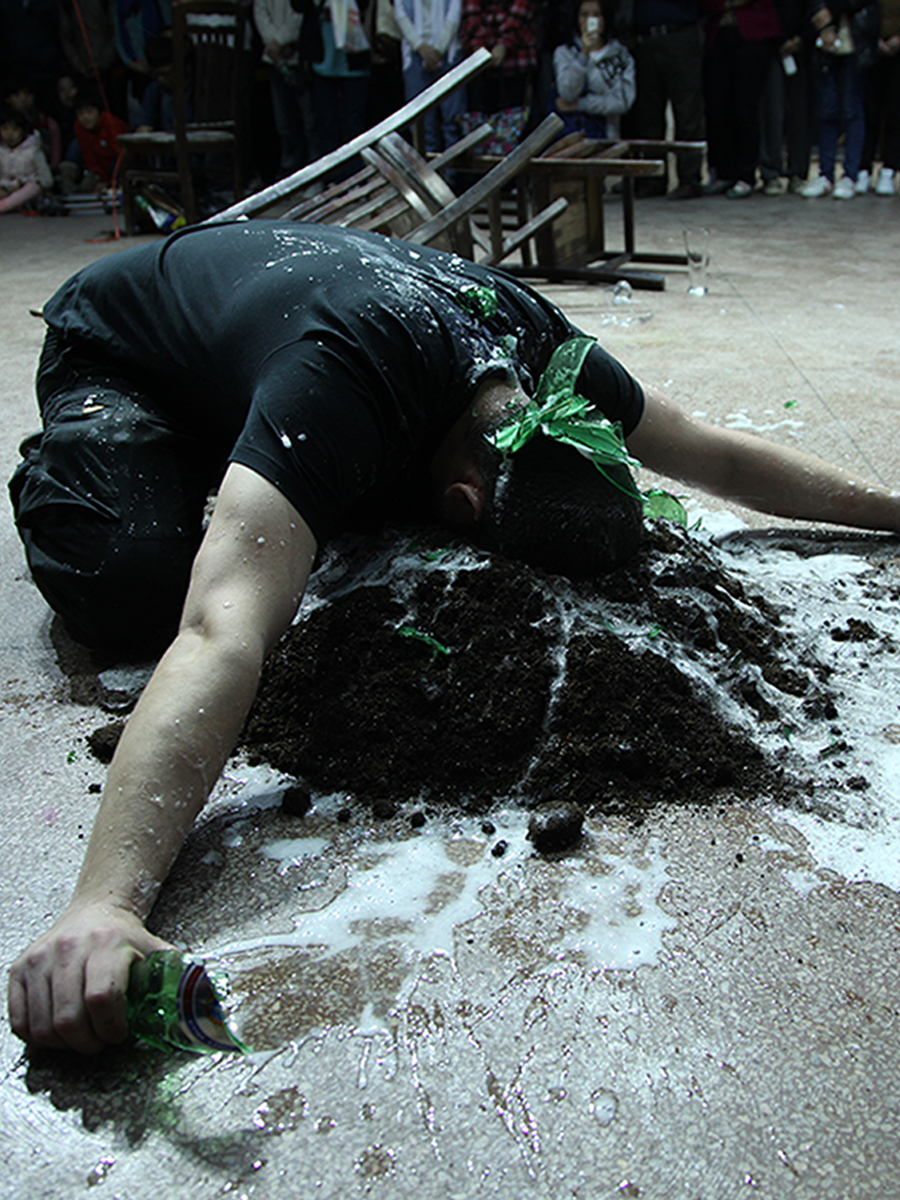
Maurice Blok. Courtesy the artist.
2026© Live Action. ALL Rights Reserved.
