
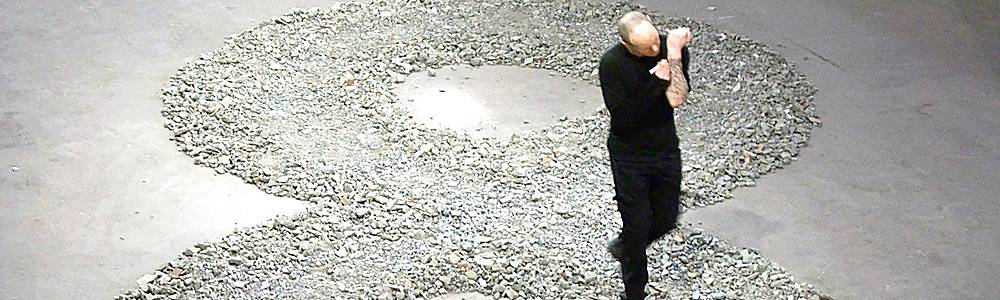
John Court, UK/Finland
Born 1969 in Bromley, Kent, United Kingdom. Lives and works in Tornio, Finland
John Court is a British-born visual and performance artist whose practice is grounded in personal experience and centred on the body, process, duration, and the passage of time. He graduated from Camberwell School of Art in London in 1994 and received a First Class Honours Degree in Sculpture from Norwich School of Art and Design in 1997. Although his practice has evolved across performance, drawing, sculpture, and context-specific work, the sculptural thinking developed during his studies remains fundamental to his approach.
Court does not draw a strict distinction between work produced in the studio and actions carried out live before an audience. For him, all artistic activity is performative. Drawing, writing, building, applying materials to surfaces, and repeatedly manipulating objects become time-based processes through which meaning gradually emerges. His works frequently respond to specific contexts, transforming familiar sculptural and graphic procedures into durational situations in which line, movement, space, and time become inseparable.
Central to Court’s practice is his complex relationship with language. Living with a severe form of dyslexia, he can grasp artistic concepts and analyse visual information while experiencing significant difficulties with reading and writing. As a young adult determined to enter art school, he worked intensively to develop his literacy skills; later, these experiences of learning, repetition, discipline, and frustration became a sustained source for his artistic practice.
Court frequently incorporates materials and objects associated with education — worktables, books, pens, chalk, paper, and other basic tools of learning — into performances, drawings, and installations. Through repetitive physical actions, these familiar objects reveal the labour involved in learning the shapes and sounds of letters, interpreting texts, pronouncing words, and writing legibly. Repetition becomes both method and subject: an embodied process through which knowledge is pursued, resisted, accumulated, and transformed over time.
For Court, knowing is doing. Meaning does not precede the action but emerges through the physical processes of making: building, drawing, writing, marking, erasing, carrying, and repeating. His performances often demand sustained concentration and endurance, allowing simple actions to accumulate into complex visual and spatial structures. The body becomes simultaneously a working instrument, a measure of duration, and a site where language is physically negotiated.
Across performance, drawing, and sculpture, Court brings together writing and image, line and movement, repetition and duration. Rooted in his own experience of dyslexia yet extending far beyond autobiography, his work transforms the struggle to acquire and use language into an embodied artistic inquiry into how knowledge is produced, how meaning takes form, and how the body learns through time.
In 2025, Court was selected to participate in the groundbreaking public hologram exhibition Immersion X in Gothenburg, Sweden. His volumetric performance is permanently situated at the entrance to the Röhsska Museum of Design, where it forms part of an innovative city-wide augmented reality exhibition that brings contemporary performance art into the urban public realm through cutting-edge holographic technology.
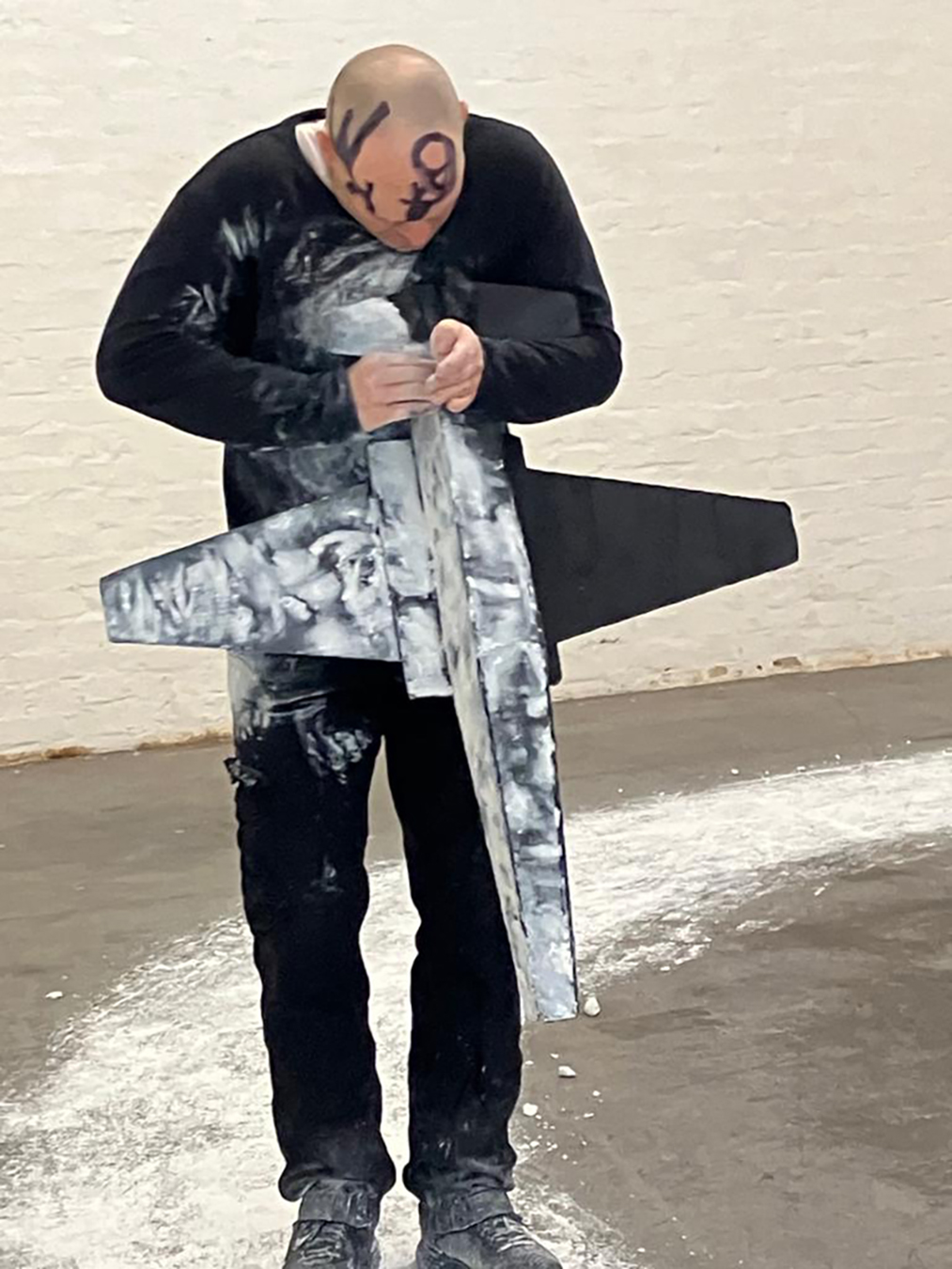
John Court. Courtesy the artist.
2026© Live Action. ALL Rights Reserved.
